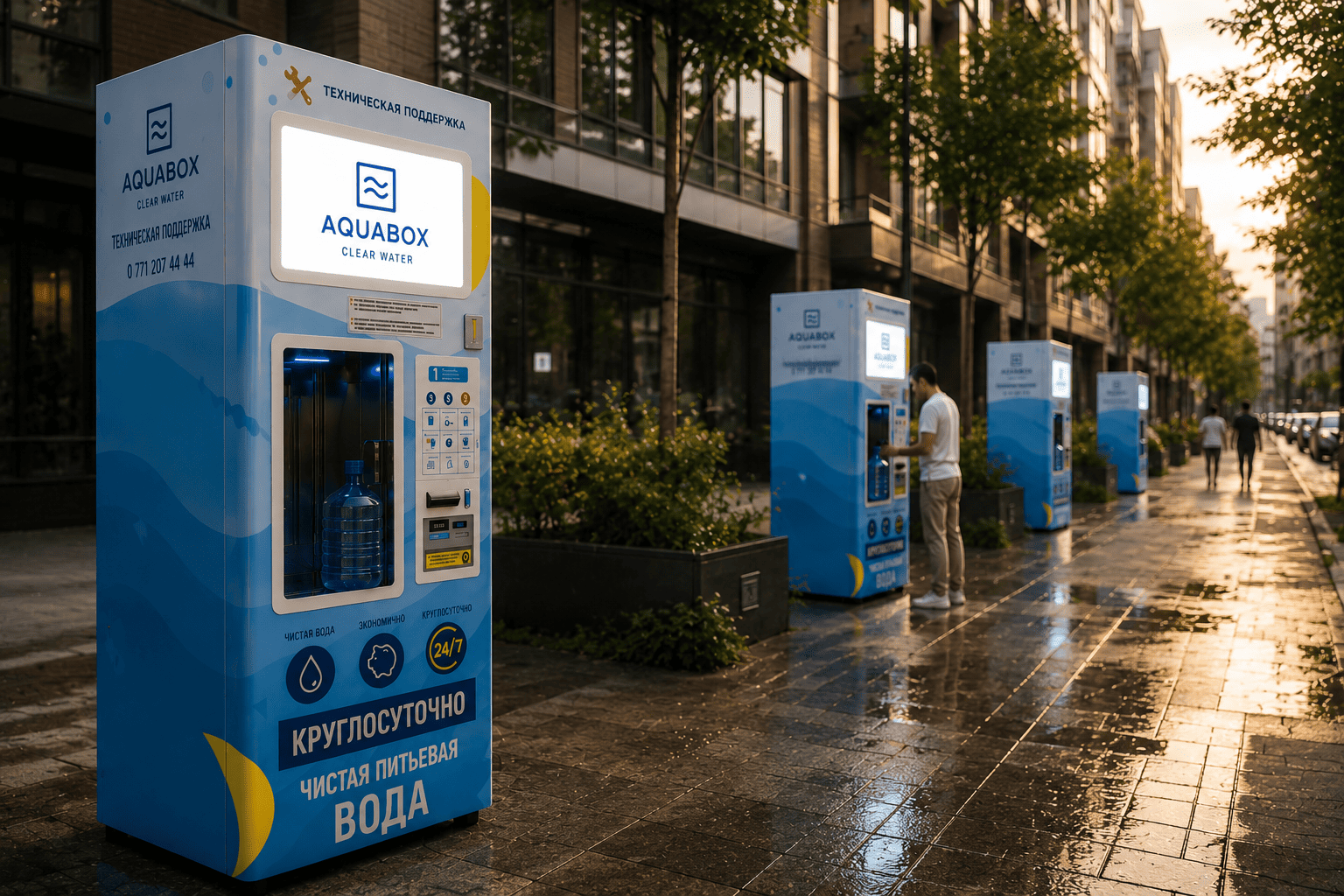
Launching a single automated water purification and sales station is a great way to test the business model, understand basic economics, and evaluate the consumer behavior of a local audience. However, the true financial efficiency and resilience of a vending business are unlocked when transitioning to a network format.
Building a network of 10 or more Aquabox points in 2026 allows an investor to diversify risks, maximize advertising revenues, and optimize operational expenses to the minimum possible values per unit of equipment.
Advantages of the Network Model (Economy of Scale)
When your business consists of a single point, any local changes (for example, a temporary water main shutdown or road repairs near the machine) can temporarily reduce operational profitability. Having a network of 10 points completely neutralizes this risk. Weakened performance at one location is compensated for by explosive growth at others.
In addition, the network model fundamentally changes the structure of your revenues and expenses:
- Interest from large advertisers: A single point with an LED screen is only interesting to local small businesses (barbershops, local training centers). A network of 10+ machines located in key residential complexes in Tashkent, Samarkand, or Bukhara is already a fully-fledged DOOH advertising media channel. Through the partner platform Muna Media, you can sell bundled placements to major brands (home appliance manufacturers, juice brands, payment systems), completely covering the rent of all locations.
- Optimization of technical maintenance (OPEX): A network of 10–15 fraction machines does not require an inflated staff. All key parameters of filtration and payments are controlled remotely via the built-in IoT module. For physical maintenance (scheduled cartridge replacement, body cleaning), it is enough to hire one mobile technical specialist with a personal car, whose labor costs will be evenly distributed across the entire network, reducing the maintenance cost of each individual machine.
Geographical Expansion: Tashkent, Samarkand, Bukhara
When scaling a business, it is important to properly distribute the geography of presence, taking into account population density and regional characteristics.
- Tashkent (Base Ground): A high concentration of new multi-story residential complexes of comfort and premium class. Consumers here are highly accustomed to cashless payments via QR codes and Uzum/Payme applications, which ensures a fast adaptation rate of the audience to the machine.
- Samarkand and Bukhara (Regional Drivers): Tourist and historical centers with high development density and a traditionally high load on water supply systems. In the regions, the problem of drinking water quality is often more acute than in the capital, which guarantees immediate demand from local residents when installing Aquabox stations in the yards of mahallas.
Thanks to a single cloud IoT platform, managing stations in Samarkand or Bukhara can be carried out centrally from your home in Tashkent. You remotely control revenue and filter status, and for physical control on-site, you engage verified local technicians under a contract.
Step-by-Step Scaling Roadmap
- Step 1: Test and Standardization (1–2 months). Launching the first 1–2 stations, fine-tuning interaction processes with the TChSZ, testing fintech acquiring.
- Step 2: Capitalization and Expansion (3–6 months). Directing the received profit and attracting additional capital volumes to purchase a pool of 3–5 machines. Developing adjacent residential areas.
- Step 3: Building a Regional Network (6–12 months). Expanding beyond the capital, concluding bundled advertising contracts for broadcasting DOOH ads across all network screens via Muna Media, and automating financial reporting for the entire structure.
Conclusion
Moving from a single machine to a managed digital network is a logical step for an investor striving to create a large and independent business in Uzbekistan. The localization of Aquabox production within the country ensures uninterrupted supplies of any amount of equipment and components, while end-to-end automation of processes allows scaling the network to 10+ points without losing control and without the need to leave home.